





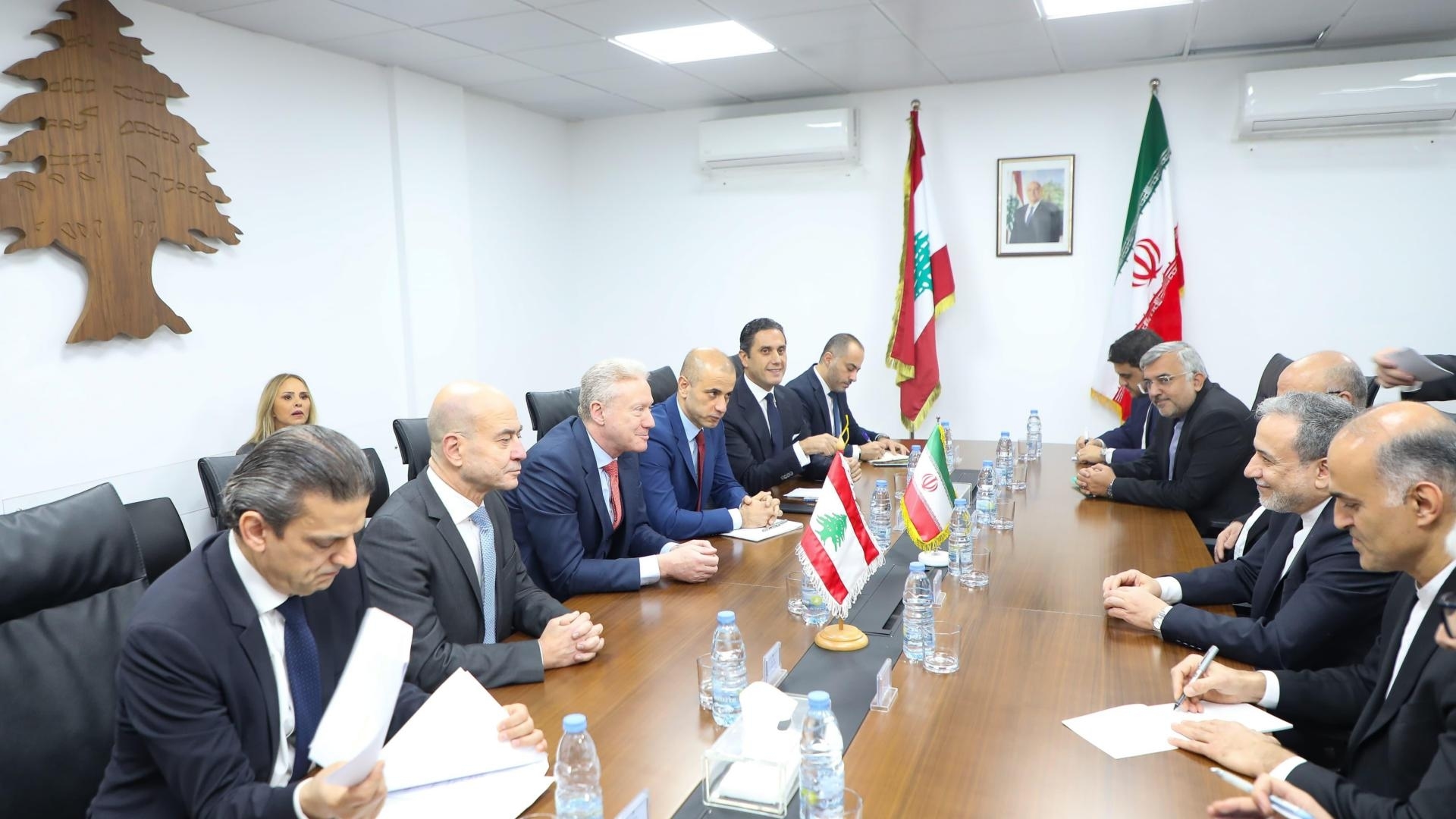

Lebanese Minister of Foreign Affairs Youssef Raggi received Iranian Foreign Minister Abbas Araghchi and the accompanying delegation. The talks were described as frank and clear, addressing a number of issues and challenges facing Lebanon, as well as bilateral relations.
Araghchi said Iran seeks to build a relationship with Lebanon based on goodwill and mutual respect within the framework of the two governments, with all their institutions and components. He considered that jointly confronting challenges and risks requires continued dialogue and consultation despite differences in approaches to certain files.
He stressed that Iran is committed to Lebanon’s independence, unity, and sovereignty, adding that defending Lebanon is a responsibility borne by the Lebanese government. He said that unity among Lebanon’s sects under the authority of the Lebanese government would help protect the country and ensure stability. Araghchi also stated that Iran supports Hezbollah as a resistance group but does not interfere in its affairs in any way, adding that any decision related to Lebanon is left to the party itself.
For his part, Raggi began by welcoming Araghchi, describing him as a friend, noting that differences in viewpoints do not undermine mutual respect. He reaffirmed Lebanon’s keenness to establish the best possible relations with Iran and its appreciation for Iran’s stated concern for Lebanon’s independence and safety, while expressing the wish that Iranian support be directed directly to the Lebanese state and its institutions rather than to any other party.
Raggi stressed that defending Lebanon is the responsibility of the Lebanese state, which, once it holds its strategic decision-making authority, controls decisions of war and peace, and monopolizes weapons, can then seek assistance from countries including Iran. He emphasized that building a state capable of defending its land and people cannot occur while an armed organization operates outside its authority, asking Araghchi whether Tehran would accept the presence of an illegal armed group on its own territory.
Raggi called on Iran to engage with Lebanon in developing a new approach to Hezbollah’s weapons, based on its relationship with the party, so that these weapons are not used as a pretext to weaken Lebanon or any of its sects. He underlined that the Shiite community is not being targeted and that the only lasting guarantee for it and for all sects lies in unity and in remaining under the authority of the state and the law. He noted that experience has shown that weapons have failed to protect the Shiite community, Lebanon, or any of its components.
Regarding reconstruction, Raggi explained that the process has not yet begun primarily due to a prevailing perception that the war has not fully ended, and because countries capable of assisting Lebanon in reconstruction are conditioning their support on disarmament. Araghchi agreed with Raggi’s assessment on reconstruction.
In conclusion, Raggi expressed hope that Araghchi would work to put an end to statements and positions by some Iranian officials that are viewed as blatant interference in Lebanese affairs.
Araghchi said Iran seeks to build a relationship with Lebanon based on goodwill and mutual respect within the framework of the two governments, with all their institutions and components. He considered that jointly confronting challenges and risks requires continued dialogue and consultation despite differences in approaches to certain files.
He stressed that Iran is committed to Lebanon’s independence, unity, and sovereignty, adding that defending Lebanon is a responsibility borne by the Lebanese government. He said that unity among Lebanon’s sects under the authority of the Lebanese government would help protect the country and ensure stability. Araghchi also stated that Iran supports Hezbollah as a resistance group but does not interfere in its affairs in any way, adding that any decision related to Lebanon is left to the party itself.
For his part, Raggi began by welcoming Araghchi, describing him as a friend, noting that differences in viewpoints do not undermine mutual respect. He reaffirmed Lebanon’s keenness to establish the best possible relations with Iran and its appreciation for Iran’s stated concern for Lebanon’s independence and safety, while expressing the wish that Iranian support be directed directly to the Lebanese state and its institutions rather than to any other party.
Raggi stressed that defending Lebanon is the responsibility of the Lebanese state, which, once it holds its strategic decision-making authority, controls decisions of war and peace, and monopolizes weapons, can then seek assistance from countries including Iran. He emphasized that building a state capable of defending its land and people cannot occur while an armed organization operates outside its authority, asking Araghchi whether Tehran would accept the presence of an illegal armed group on its own territory.
Raggi called on Iran to engage with Lebanon in developing a new approach to Hezbollah’s weapons, based on its relationship with the party, so that these weapons are not used as a pretext to weaken Lebanon or any of its sects. He underlined that the Shiite community is not being targeted and that the only lasting guarantee for it and for all sects lies in unity and in remaining under the authority of the state and the law. He noted that experience has shown that weapons have failed to protect the Shiite community, Lebanon, or any of its components.
Regarding reconstruction, Raggi explained that the process has not yet begun primarily due to a prevailing perception that the war has not fully ended, and because countries capable of assisting Lebanon in reconstruction are conditioning their support on disarmament. Araghchi agreed with Raggi’s assessment on reconstruction.
In conclusion, Raggi expressed hope that Araghchi would work to put an end to statements and positions by some Iranian officials that are viewed as blatant interference in Lebanese affairs.