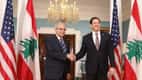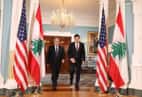







Lebanon’s Ambassador to the United States, Nada Hamadeh Moawad, hosted a dinner at the Lebanese Embassy residence in Washington in honor of Prime Minister Nawaf Salam and his wife, Ambassador Sahar Baassiri Salam.
The dinner was attended by Foreign Minister Youssef Raggi, Finance Minister Yassine Jaber, Energy Minister Joe Saddi, senior U.S. officials, diplomats, representatives of international financial institutions, and prominent media figures.
Among the U.S. officials in attendance were U.S. Ambassador to the United Nations Mike Waltz; Deputy National Security Advisors Michael Needham and Joseph Cutler; Deputy Secretary of Energy James Danly; Deputy Secretary of Commerce Paul Dabbar; State Department Counselor Dan Holler; Under Secretary of State Hooker; Assistant Secretaries of State Blome and Namdar; Assistant Secretaries of the Treasury Burke and Greenstein; Assistant Secretary of Commerce Fogel; White House National Cyber Director Cairncross; Chairman of the White House Council of Economic Advisers Phelan; Assistant to the President Sebastian Gorka; DFC Head of Investments Coleman; and Congressman Darrell Issa.
The gathering also included Saudi Special Envoy to Lebanon Prince Yazeed bin Farhan; U.S. Ambassador to Lebanon Michel Issa; the ambassadors of the UAE, Qatar, Jordan, Egypt, Oman, Kuwait, Iraq and Syria to the United States; the World Bank Executive Director; the IMF Director for the Middle East and Central Asia; and prominent media figures.
In her welcoming remarks, Ambassador Hamadeh Moawad described Salam’s visit to Washington as taking place at a pivotal moment for Lebanon.
“Your meetings with Secretary of State Marco Rubio, Secretary of the Treasury Scott Bessent, World Bank Group President Ajay Banga, and IMF Managing Director Kristalina Georgieva underscore the importance of Lebanon’s partnership with the United States and with international financial institutions,” she said.
She added that the meetings also reflected “the urgent task before us: restoring confidence, advancing economic and financial reforms, attracting investment, rebuilding our institutions and infrastructure, and creating the conditions for sustainable growth and prosperity for the Lebanese people.”
“We are confident that your visit will help strengthen Lebanon’s international partnerships and mobilize support for the country’s economic recovery and long-term stability,” she said.
Prime Minister Salam then addressed the gathering, thanking Ambassador Hamadeh Moawad and the guests for taking the time to engage with Lebanon.
“I want to start with a simple message. For months, Lebanon has been asked: What is Lebanon prepared to do? I believe it is time to move beyond that question. Lebanon has made its choice,” Salam said.
“We have chosen that there can be no authority above the authority of the state, no weapons outside its legitimate institutions, and no decision of war and peace outside its constitutional processes.
“We have chosen reform over the practices that brought our financial system and economy to collapse. And we have chosen diplomacy over permanent war as the path to recover our territory, protect our people, and achieve lasting security and peace.
“We have charted our course. I am here to discuss how Lebanon and the United States can work together to turn that choice into an irreversible reality.”
Lebanon-U.S. relations
Addressing Lebanon’s relationship with the United States, Salam said American interest in Lebanon “cannot be reduced to preventing another war on Israel’s northern border.”
“The relationship between our societies is almost two centuries old,” he said, noting that American educators came to Beirut in the 19th century and that generations of Lebanese emigrated to the United States and became part of American society.
“There is also something deeper that connects our peoples,” Salam said. “While Lebanon is proudly Arab and deeply rooted in its region, it shares with the United States a commitment to freedom of thought and expression, entrepreneurship, openness, individual initiative, diversity and political pluralism.”
“But today, the Lebanon built on these values is at a crossroads,” he added.
Salam said Lebanon was facing “existential challenges,” adding that his government had taken office with a clear objective: rebuilding the state and restoring the Lebanese people’s confidence in its institutions.
“We are pursuing that objective on two fundamental tracks: sovereignty and reform,” he said.
On the reform front, Salam said Lebanon had made substantial progress, including amendments to the bank secrecy law and approval of amendments to the Bank Resolution Law in line with IMF recommendations.
“We are working on the Financial Stabilization and Deposits Recovery Law—known as the financial gap law—which is essential to resolving the depositor crisis, rebuilding a viable banking system and reaching an agreement with the IMF,” he said.
Financial reform and state sovereignty
Salam linked financial reform directly to the restoration of state sovereignty, saying the collapse of Lebanon’s banking system had created a vast cash economy and expanded the space for illicit finance, unregulated transfers and parallel financial networks.
“If we want to constrain those networks, we need to build a robust and regulated financial system. Such a system is an essential pillar of rebuilding our sovereignty,” he said.
Turning to the state’s monopoly over arms, Salam said this was another fundamental pillar of restoring sovereignty.
“Let me be clear: such a monopoly must extend to the entirety of Lebanese territory, both south and north of the Litani River,” he said. “It applies to Hezbollah and to every other armed non-state actor, whether in the South, Beirut, the Beqaa, or anywhere else.”
Salam stressed, however, that restoring sovereignty went beyond the issue of weapons.
“At Beirut airport, we have reasserted the authority of the state over a critical point of entry into Lebanon. At our ports, we have strengthened the role of the state and its security and customs institutions. At our border with Syria, we have increased the presence and responsibilities of the Lebanese Armed Forces and security agencies,” he said.
“In the South, the Lebanese Armed Forces had begun expanding the state’s exclusive authority, only for that process to be disrupted by the outbreak of war on March 2.”
Strengthening the Lebanese state
Salam said restoring state authority also required addressing “entrenched habits and institutional dysfunctions.”
“Where there is political hesitation, we must overcome it. Where there are implementation shortcomings, we must address them. Where there are capability gaps, we must fill them,” he said.
“If the objective is one sovereign Lebanese state, it is the Lebanese Armed Forces, alongside our other legitimate security institutions, and only them, that must secure our borders, control our territory and uphold the state’s monopoly over arms.”
He stressed that strengthening the Army’s capabilities in intelligence, surveillance, mobility, communications, equipment and training would enhance its ability to extend state authority and assume the responsibilities assigned to it.
Salam also stressed that a stronger and more effective Army alone would not be enough to address Lebanon’s challenges following the war.
“After a war that was imposed on us—a war that we neither chose nor wanted—more than 4,000 people were killed, over 10,000 were injured, and more than one million people were displaced at its peak, not to mention thousands of homes destroyed and entire villages completely wiped out,” he said.
He said residents of war-affected areas were asking who would rebuild schools, repair damaged water, electricity and telecommunications infrastructure, help businesses reopen and enable families to return safely to their homes.
“Only when the state can rise to these challenges will it not only gain legitimacy but also be in a position to win the hearts and minds of local communities,” Salam said.
The trilateral framework
Turning to the trilateral framework, Salam said Lebanon had opted for negotiations and diplomacy, which resulted in the framework signed in Washington, because Beirut believed the process could help restore Lebanese sovereignty through an Israeli withdrawal and the establishment of the state’s monopoly over arms across Lebanese territory.
“The framework is based on two constructive principles: reciprocal and sequential moves,” he said. “However, to move forward, we need to operationalize these principles. And here, we are counting on American leadership.”
Salam outlined three requirements for advancing the process.
“First, a clear timeframe for Israeli withdrawal and for the implementation of the state’s monopoly over arms. These processes must advance simultaneously,” he said.
“Second, a credible verification mechanism must be put in place. Such a mechanism would ensure that commitments on both sides are verified, and that neither can indefinitely invoke the other’s inaction as justification for its own.”
“Third, we must rally international partners to actively support the Government in rebuilding the country, repairing infrastructure, restoring the economy and, as provided for in the framework, enabling the return of the displaced.”
Salam concluded by stressing that the trilateral framework should produce concrete changes on the ground.
“We cannot allow the trilateral Framework to become yet another process that merely manages the conflict instead of resolving it. We need it to change the reality on the ground. We need it to deliver tangible results. We need it to succeed.”
The dinner was attended by Foreign Minister Youssef Raggi, Finance Minister Yassine Jaber, Energy Minister Joe Saddi, senior U.S. officials, diplomats, representatives of international financial institutions, and prominent media figures.
Among the U.S. officials in attendance were U.S. Ambassador to the United Nations Mike Waltz; Deputy National Security Advisors Michael Needham and Joseph Cutler; Deputy Secretary of Energy James Danly; Deputy Secretary of Commerce Paul Dabbar; State Department Counselor Dan Holler; Under Secretary of State Hooker; Assistant Secretaries of State Blome and Namdar; Assistant Secretaries of the Treasury Burke and Greenstein; Assistant Secretary of Commerce Fogel; White House National Cyber Director Cairncross; Chairman of the White House Council of Economic Advisers Phelan; Assistant to the President Sebastian Gorka; DFC Head of Investments Coleman; and Congressman Darrell Issa.
The gathering also included Saudi Special Envoy to Lebanon Prince Yazeed bin Farhan; U.S. Ambassador to Lebanon Michel Issa; the ambassadors of the UAE, Qatar, Jordan, Egypt, Oman, Kuwait, Iraq and Syria to the United States; the World Bank Executive Director; the IMF Director for the Middle East and Central Asia; and prominent media figures.
In her welcoming remarks, Ambassador Hamadeh Moawad described Salam’s visit to Washington as taking place at a pivotal moment for Lebanon.
“Your meetings with Secretary of State Marco Rubio, Secretary of the Treasury Scott Bessent, World Bank Group President Ajay Banga, and IMF Managing Director Kristalina Georgieva underscore the importance of Lebanon’s partnership with the United States and with international financial institutions,” she said.
She added that the meetings also reflected “the urgent task before us: restoring confidence, advancing economic and financial reforms, attracting investment, rebuilding our institutions and infrastructure, and creating the conditions for sustainable growth and prosperity for the Lebanese people.”
“We are confident that your visit will help strengthen Lebanon’s international partnerships and mobilize support for the country’s economic recovery and long-term stability,” she said.
Prime Minister Salam then addressed the gathering, thanking Ambassador Hamadeh Moawad and the guests for taking the time to engage with Lebanon.
“I want to start with a simple message. For months, Lebanon has been asked: What is Lebanon prepared to do? I believe it is time to move beyond that question. Lebanon has made its choice,” Salam said.
“We have chosen that there can be no authority above the authority of the state, no weapons outside its legitimate institutions, and no decision of war and peace outside its constitutional processes.
“We have chosen reform over the practices that brought our financial system and economy to collapse. And we have chosen diplomacy over permanent war as the path to recover our territory, protect our people, and achieve lasting security and peace.
“We have charted our course. I am here to discuss how Lebanon and the United States can work together to turn that choice into an irreversible reality.”
Lebanon-U.S. relations
Addressing Lebanon’s relationship with the United States, Salam said American interest in Lebanon “cannot be reduced to preventing another war on Israel’s northern border.”
“The relationship between our societies is almost two centuries old,” he said, noting that American educators came to Beirut in the 19th century and that generations of Lebanese emigrated to the United States and became part of American society.
“There is also something deeper that connects our peoples,” Salam said. “While Lebanon is proudly Arab and deeply rooted in its region, it shares with the United States a commitment to freedom of thought and expression, entrepreneurship, openness, individual initiative, diversity and political pluralism.”
“But today, the Lebanon built on these values is at a crossroads,” he added.
Salam said Lebanon was facing “existential challenges,” adding that his government had taken office with a clear objective: rebuilding the state and restoring the Lebanese people’s confidence in its institutions.
“We are pursuing that objective on two fundamental tracks: sovereignty and reform,” he said.
On the reform front, Salam said Lebanon had made substantial progress, including amendments to the bank secrecy law and approval of amendments to the Bank Resolution Law in line with IMF recommendations.
“We are working on the Financial Stabilization and Deposits Recovery Law—known as the financial gap law—which is essential to resolving the depositor crisis, rebuilding a viable banking system and reaching an agreement with the IMF,” he said.
Financial reform and state sovereignty
Salam linked financial reform directly to the restoration of state sovereignty, saying the collapse of Lebanon’s banking system had created a vast cash economy and expanded the space for illicit finance, unregulated transfers and parallel financial networks.
“If we want to constrain those networks, we need to build a robust and regulated financial system. Such a system is an essential pillar of rebuilding our sovereignty,” he said.
Turning to the state’s monopoly over arms, Salam said this was another fundamental pillar of restoring sovereignty.
“Let me be clear: such a monopoly must extend to the entirety of Lebanese territory, both south and north of the Litani River,” he said. “It applies to Hezbollah and to every other armed non-state actor, whether in the South, Beirut, the Beqaa, or anywhere else.”
Salam stressed, however, that restoring sovereignty went beyond the issue of weapons.
“At Beirut airport, we have reasserted the authority of the state over a critical point of entry into Lebanon. At our ports, we have strengthened the role of the state and its security and customs institutions. At our border with Syria, we have increased the presence and responsibilities of the Lebanese Armed Forces and security agencies,” he said.
“In the South, the Lebanese Armed Forces had begun expanding the state’s exclusive authority, only for that process to be disrupted by the outbreak of war on March 2.”
Strengthening the Lebanese state
Salam said restoring state authority also required addressing “entrenched habits and institutional dysfunctions.”
“Where there is political hesitation, we must overcome it. Where there are implementation shortcomings, we must address them. Where there are capability gaps, we must fill them,” he said.
“If the objective is one sovereign Lebanese state, it is the Lebanese Armed Forces, alongside our other legitimate security institutions, and only them, that must secure our borders, control our territory and uphold the state’s monopoly over arms.”
He stressed that strengthening the Army’s capabilities in intelligence, surveillance, mobility, communications, equipment and training would enhance its ability to extend state authority and assume the responsibilities assigned to it.
Salam also stressed that a stronger and more effective Army alone would not be enough to address Lebanon’s challenges following the war.
“After a war that was imposed on us—a war that we neither chose nor wanted—more than 4,000 people were killed, over 10,000 were injured, and more than one million people were displaced at its peak, not to mention thousands of homes destroyed and entire villages completely wiped out,” he said.
He said residents of war-affected areas were asking who would rebuild schools, repair damaged water, electricity and telecommunications infrastructure, help businesses reopen and enable families to return safely to their homes.
“Only when the state can rise to these challenges will it not only gain legitimacy but also be in a position to win the hearts and minds of local communities,” Salam said.
The trilateral framework
Turning to the trilateral framework, Salam said Lebanon had opted for negotiations and diplomacy, which resulted in the framework signed in Washington, because Beirut believed the process could help restore Lebanese sovereignty through an Israeli withdrawal and the establishment of the state’s monopoly over arms across Lebanese territory.
“The framework is based on two constructive principles: reciprocal and sequential moves,” he said. “However, to move forward, we need to operationalize these principles. And here, we are counting on American leadership.”
Salam outlined three requirements for advancing the process.
“First, a clear timeframe for Israeli withdrawal and for the implementation of the state’s monopoly over arms. These processes must advance simultaneously,” he said.
“Second, a credible verification mechanism must be put in place. Such a mechanism would ensure that commitments on both sides are verified, and that neither can indefinitely invoke the other’s inaction as justification for its own.”
“Third, we must rally international partners to actively support the Government in rebuilding the country, repairing infrastructure, restoring the economy and, as provided for in the framework, enabling the return of the displaced.”
Salam concluded by stressing that the trilateral framework should produce concrete changes on the ground.
“We cannot allow the trilateral Framework to become yet another process that merely manages the conflict instead of resolving it. We need it to change the reality on the ground. We need it to deliver tangible results. We need it to succeed.”