






Digital Trends
A tiny frozen world three billion miles away from the sun isn’t the place where you might expect to find a brilliant blue sky, but that’s exactly what NASA’s New Horizons team has discovered on far-off Pluto.
Of course, if you were to somehow stand on Pluto and look up, the sky above your head would still look black. Pluto’s atmosphere is much too thin to actually fill in with scattered light. But at sunset and sunrise -- which, on Pluto, are about 3.2 Earth-days apart -- you might see the horizon illuminated by a lovely blue glow.
The image above is a color-composite made from data acquired by New Horizons’ Ralph/Multispectral Visible Imaging Camera (MVIC) as the spacecraft was traveling away from Pluto after its historic close encounter on July 14. It shows the silhouette of Pluto backlit by the sun, surrounded by a sky-blue multilayered haze.
“Who would have expected a blue sky in the Kuiper Belt? It’s gorgeous,” said Alan Stern, principal investigator for the New Horizons mission from the Southwest Research Institute in Boulder, Colorado.
Here on Earth, the daytime sky appears blue because of the way molecules of nitrogen and oxygen in the atmosphere disperse visible light from the sun, an effect called Rayleigh scattering. Shorter blue wavelengths are scattered more effectively, giving the sky its blue color.
On Pluto, 33 times farther from the sun than Earth is, light from our star is scattered through layers of atmospheric haze in much the same way — except there it’s not by molecules of oxygen or nitrogen but by very tiny soot-like particles called tholins.
The tholins are created from the breakdown of nitrogen and methane in Pluto’s atmosphere by ultraviolet radiation from the sun, a complex chemical process also found at Saturn’s moon Titan. Individual tholin particles themselves aren’t blue but rather grey or red in color; eventually they grow large and heavy enough to “rain” down onto Pluto’s surface — the likely source of its large red-stained areas.
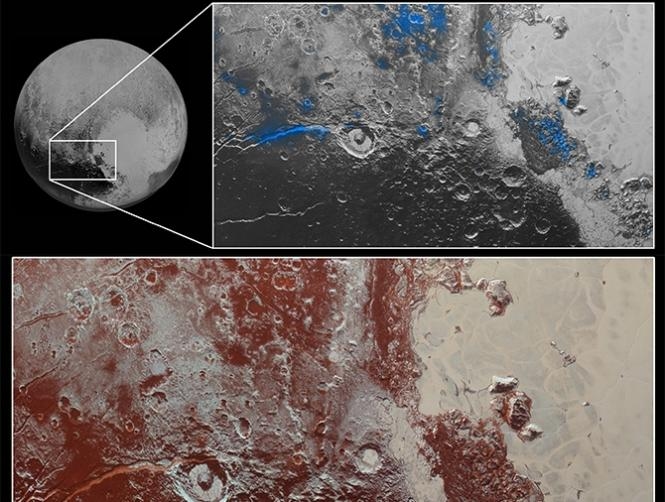
In addition to a cerulean sky the New Horizons team also identified areas of exposed water ice on Pluto. While you might expect ice to be covering a world located in the far frozen reaches of the Kuiper Belt, on Pluto much of the surface hasn’t been found to have ice made of water but rather other more volatile substances, like nitrogen.
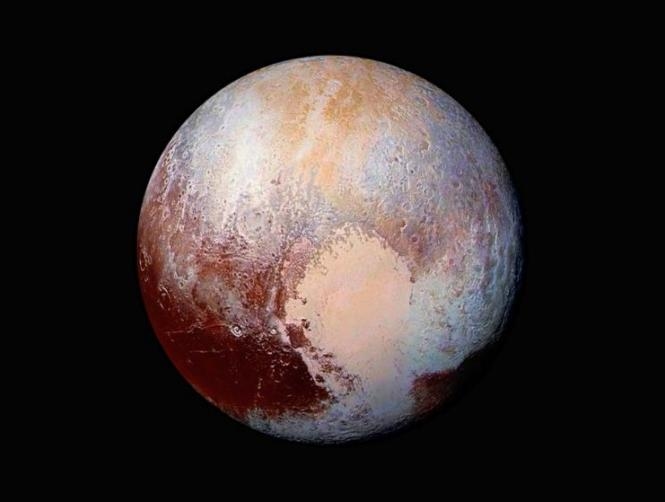
Curiously, the areas that show signatures of water ice are also regions that have shown up in high-resolution color image as particularly bright red — have these also been stained by tholins from Pluto’s atmosphere?
“I’m surprised that this water ice is so red,” says Silvia Protopapa, a science team member from the University of Maryland, College Park. “We don’t yet understand the relationship between water ice and the reddish tholin colorants on Pluto’s surface.”